

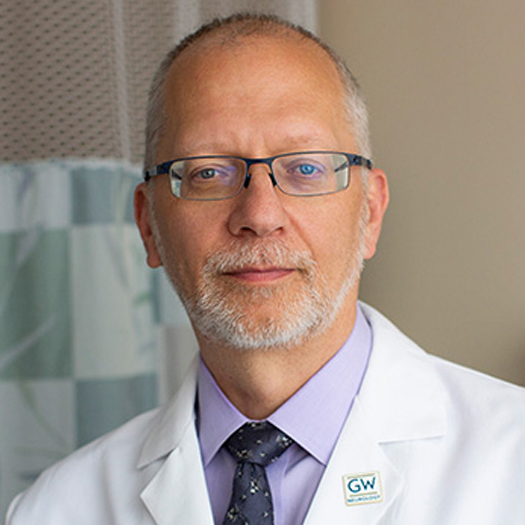
Henry Kaminsk, MD
Jeffrey Lieberman Professor of Neuroscience, George Washington University, Principal Investigator, Myasthenia Gravis Rare Disease Network (MGNet)
Artificial intelligence (AI) holds great potential to advance rare disease research. Here’s how scientists and physicians are using AI to improve outcomes for people living with rare diseases.
How is AI used in rare disease research?
Dr Kaminski: AI encompasses a broad set of applications. Scientists and physicians are using sophisticated computer vision or wearable sensors to collect large amounts of data from patients, then applying machine learning techniques to identify unexpected patterns.
I think among the most exciting potential applications for rare disease research is to develop computer modelling of the natural history of a patient. We can then use those models as a digital arm in a clinical trial, which could substitute for a placebo arm. This is critical to develop in rare disease research because only a few patients are available for study.
How can AI improve outcomes for patients and families?
Dr Kaminski: A significant problem in rare diseases is that there are few experts. General paediatricians, internists or even specialists are not going to necessarily recognise rare diseases. This diagnostic delay can be one, two, or multiple years, decades even, for some patients. However, these individuals are definitely coming in to seek medical advice.
Now it’s possible to interrogate the electronic health record systematically to identify patterns for these rare diseases, and potentially then alert the physician to the diagnosis.
A significant problem in rare diseases is that there are few experts.
What excites you about the future of research with AI?
Dr Kaminski: So many things — from identifying biological mechanisms, speeding diagnosis, improving clinical trial performance and then ultimately translating these advances to patient care. All these things are possible because of the ability of AI to see patterns and identify commonalities that could not be done by a single human.
Learn more about research — including AI utilisation — from the Rare Diseases Clinical Research Network (RDCRN).