

Professor Pallav Shah
Consultant Physician in Respiratory Medicine, Royal Brompton Hospital
Worrying about a persistent cough? Early lung cancer detection is vital for better outcomes – and diagnostic technology has advanced greatly.
Winter is the season for coughs and colds, the vast majority of which are due to viral infections. However, if a cough persists for more than four weeks, don’t ignore it. See your GP and, ideally, ask for a chest X-ray, says Professor Pallav Shah, consultant physician in respiratory medicine at Royal Brompton Hospital, part of Guy’s and St Thomas’ NHS Foundation Trust.
Targeted screening for those at increased risk
Professor Shah stresses that, if tumours are discovered in the lungs, the earlier treatment starts, the more successful the outcome is likely to be.
“Thankfully, the UK has one of the best lung cancer screening programmes in the world,” comments Professor Shah. “It’s picking up people who are at increased risk of the disease before symptoms appear. And it’s making a real difference because the reality is, early lung cancer doesn’t present with any signs or symptoms. By the time red flag symptoms do present — including a cough, phlegm, coughing up blood, pain and difficulty swallowing — tumours will be much bigger and have had the potential to spread.” Known as a targeted lung health check, the programme is available on the NHS to current and former smokers, aged 55-74.
if a cough persists for more than four weeks, don’t ignore it
Breakthrough diagnostic technology for lung cancer
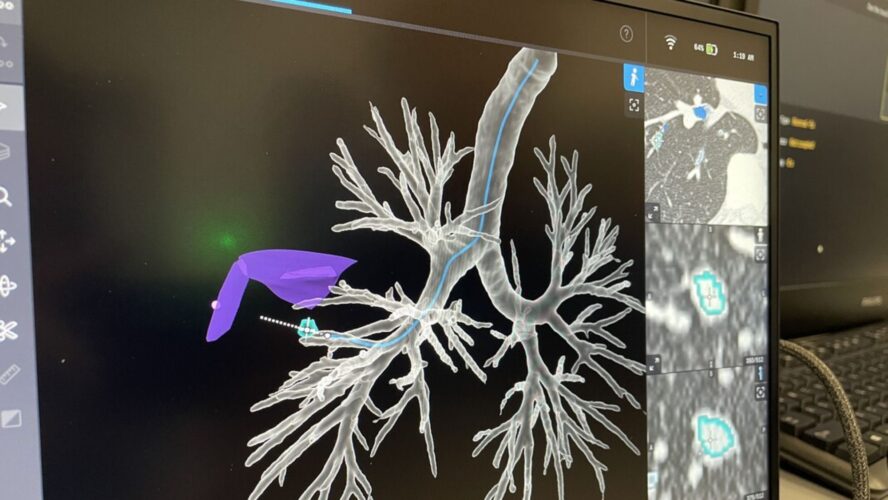
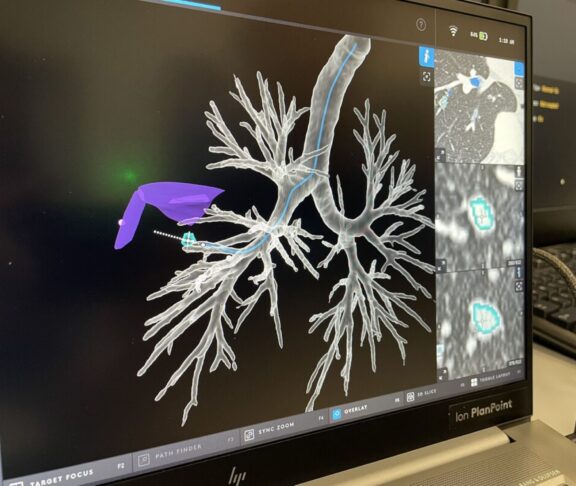
The UK is also home to some of the best diagnostic innovations worldwide. Since 2023, Royal Brompton Hospital has been trialling new robotic technology, the Ion Endoluminal System, an innovative robotic device from technology company Intuitive, which enters the airways orally and can find and sample lung nodules that are hard to reach and as small as four millimetres.
This isn’t possible with a traditional bronchoscopy, says Professor Shah, who calls the pioneering tech a breakthrough for patient outcomes because it can detect early-stage cancer precisely. Furthermore, where suspicious nodules are found, they can be ablated during the same procedure using a new microwave catheter technology — a type of ablation tool called the MicroBlate Flex, from UK company Creo.
Oncology is an area that’s constantly innovating. “At Royal Brompton, we’ve developed around five technologies which have gone from conception and trials through to global standards,” says Professor Shah. “For example, 20 years ago, we introduced endobronchial ultrasound (EBUS) to sample glands in the lungs, now used globally as the standard of care for diagnosing lymph node abnormalities and the staging of lung cancer. We tend to see important innovation leaps every five to 10 years. Another advantage of this latest diagnostic robotic technology is, it will facilitate other innovations to benefit patients in the years ahead.”
Find out more at World-leading private care – Guys and St Thomas Specialist Care